
Actuator Physics (Part 2): Spring Range Selection — The Difference Between Bench Set and Installed Range
This is Article No.011 of “100 Articles on Control Valve Knowledge” On the nameplate of a control valve, you will often see a parameter like this: Spring Range (Bench Set): 0.8 – 2.4 bar At this moment, if you take a 4-20mA positioner (corresponding to 0.2-1.0 bar) and try to commission this valve, you may […]
The Ghost in the Control Loop: Deadband, Hysteresis, and Stiction — Which One Is the “Control Loop Killer”?
Have you ever encountered either of these situations? The flow trend on the DCS remains a perfectly flat line, even though it responds when the setpoint changes. Or the flow trend oscillates continuously like a sine wave. No matter how gently you tune the PID parameters, the oscillation just will not stop. When this happens, […]
The Myth of Valve Rangeability: Why Do Manufacturers Claim 50:1 When You Can’t Even Use 10:1 in the Field?
When reviewing a control valve data sheet, you will often come across an impressive specification: Rangeability: 50:1, or even 100:1. Many engineers see this figure and feel reassured: “My maximum flow rate is 100, and my minimum flow rate is 2. The required ratio is only 50:1, so this valve should easily handle the job.” […]
Leakage Classes and Rangeability: The “Lower Limit” and “Upper Limit” of Control Valve Performance
Control Valve Knowledge Series — No.007 Leakage Classes and Rangeability: The “Lower Limit” and “Upper Limit” of Control Valve Performance Keywords: Leakage Class, ANSI/FCI 70-2, Rangeability, Turndown Ratio, Class VI 📝 Introduction If the Cv value determines how much work a valve can do, then leakage class and rangeability determine how well it performs. Leakage Class The lower […]
The Story of the Cv Flow Coefficient: From Definition to Calculation — A Guide to Avoiding Common Pitfalls
Keywords: Cv Value, Kv Value, Flow Calculation, Valve Sizing, Choked Flow 📝 Introduction: Key Takeaways On a control valve datasheet, one of the most prominent parameters is always the Cv value. It is the “currency” of a valve’s flow capacity. If the valve is oversized, it may operate at very small openings for extended periods, potentially […]
The truth about flow Characteristics

Why do we recommend the seemingly complex “equal percentage” valve over the intuitively simple “linear” valve in 90% of process control applications? Many engineers assume that controlling a linear process requires a linear valve. This is a massive misconception. In real-world piping systems, ideal “inherent characteristics” are inevitably distorted by harsh realities into “installed characteristics.” […]
An Introduction to Control Valve Physics: The Interplay of Pressure, Flow Rate, and Energy Dissipation

In the field of process industries, we are accustomed to talking about “opening,” “flow rate,” and “pressure differential.” However, if we view a control valve through the lens of fluid mechanics, you’ll realize it’s not just a mechanical device for regulating fluid, but a precision energy converter. Why does a high pressure drop generate deafening […]
Defeating the “Silent Killer”: A Technical Guide to NACE MR0175 Industrial Valves for Sour Service

In the demanding environments of upstream oil and gas production and downstream refining, one chemical compound stands out as a primary threat to infrastructure integrity: Hydrogen Sulfide (H2S). For engineers, H2S is not just a toxic gas; it is the catalyst for a catastrophic material failure known as Sulfide Stress Cracking (SSC). At SFANVALVE, we […]
Technical Analysis of Oxygen Service in Fluid Control: Combustion Risk Mitigation, Material Science, and Precision Degreasing Protocols
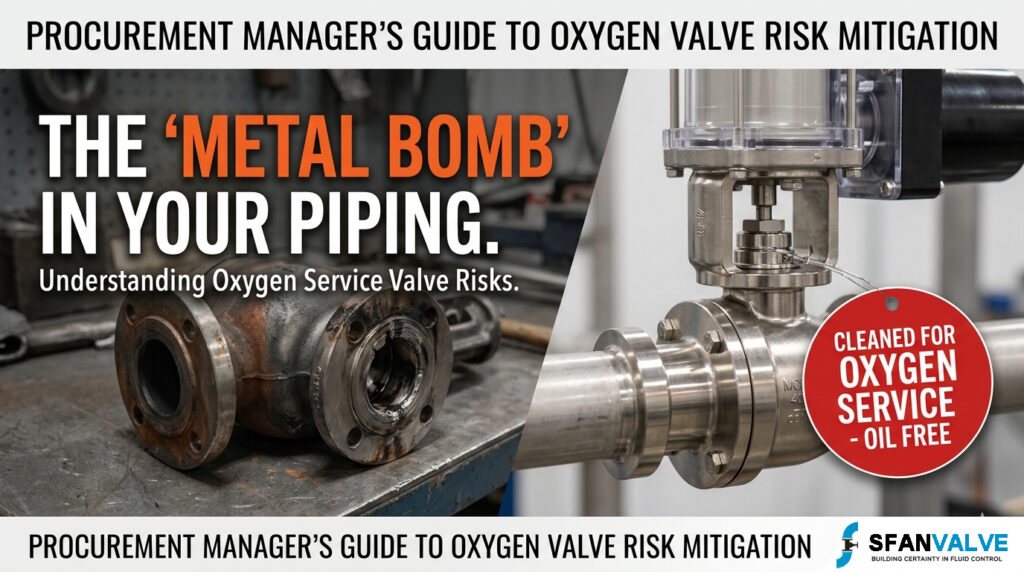
The handling of high-purity gaseous oxygen (GOX) and liquid oxygen (LOX) represents one of the most critical challenges in modern fluid control and valve engineering. While atmospheric air, containing approximately 21% oxygen, is generally inert to metallic structural components, an increase in oxygen concentration to levels exceeding 23.5% transforms the chemical environment into a highly […]
Cryogenic Valve Engineering and Design Optimization: Comprehensive Analysis of Extended Bonnet Mechanics, Cold Box Integration, and B2B Procurement Standards for Global LNG Infrastructure
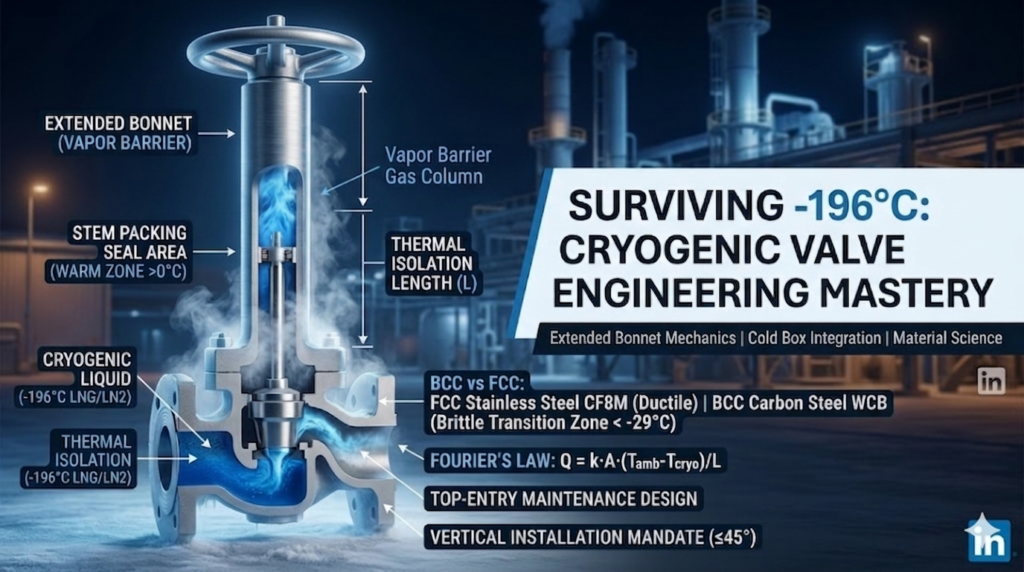
The global cryogenic valve market represents a critical segment of the industrial fluid control industry, driven by the escalating demand for Liquefied Natural Gas (LNG), industrial gases, and emerging hydrogen energy infrastructure. Valued at approximately USD 4.82 billion in 2025, the market is projected to expand to USD 8.91 billion by 2034, representing a compound […]