
In the demanding environments of upstream oil and gas production and downstream refining, one chemical compound stands out as a primary threat to infrastructure integrity: Hydrogen Sulfide (H2S). For engineers, H2S is not just a toxic gas; it is the catalyst for a catastrophic material failure known as Sulfide Stress Cracking (SSC).
At SFANVALVE, we have spent over 15 years engineering flow control solutions that withstand these “sour” conditions. Understanding the interplay between metallurgy and chemistry isn’t just about compliance—it’s about preventing “invisible” brittle failures that can lead to sudden, disastrous ruptures in the field.
The Mechanism of Sulfide Stress Cracking (SSC)
SSC is a specific form of hydrogen embrittlement. When wet H2S contacts a metal surface, a corrosion reaction occurs:

While most hydrogen atoms combine into harmless gas molecules, the presence of sulfide ions acts as a “poison,” forcing single hydrogen atoms to diffuse into the metal’s crystalline lattice. Once inside, these atoms accumulate at high-stress areas or grain boundaries. If the material is too hard or under significant tensile stress, the internal pressure causes the metal to crack and fail without any prior plastic deformation or warning.
When is NACE MR0175/ISO 15156 Mandatory?
Selection of a NACE-compliant valve is not arbitrary. According to the international standard ISO 15156, compliance is required whenever the absolute partial pressure of H2S (PH2S) in a gas phase exceeds 0.05 psia( 0.003MPa).
To calculate your requirement, use the following logic:

In high-pressure systems, even a few parts per million (ppm) of H2S can push the partial pressure over the threshold. For example, at a total pressure of 3000 psi, a concentration of only 17ppm H2S requires a NACE-certified valve.
The SFAN Engineering Approach: Hardness vs. Durability
The core philosophy of NACE MR0175 can be summarized in one rule: Control the Hardness.
1. Carbon Steel Body and Bonnets
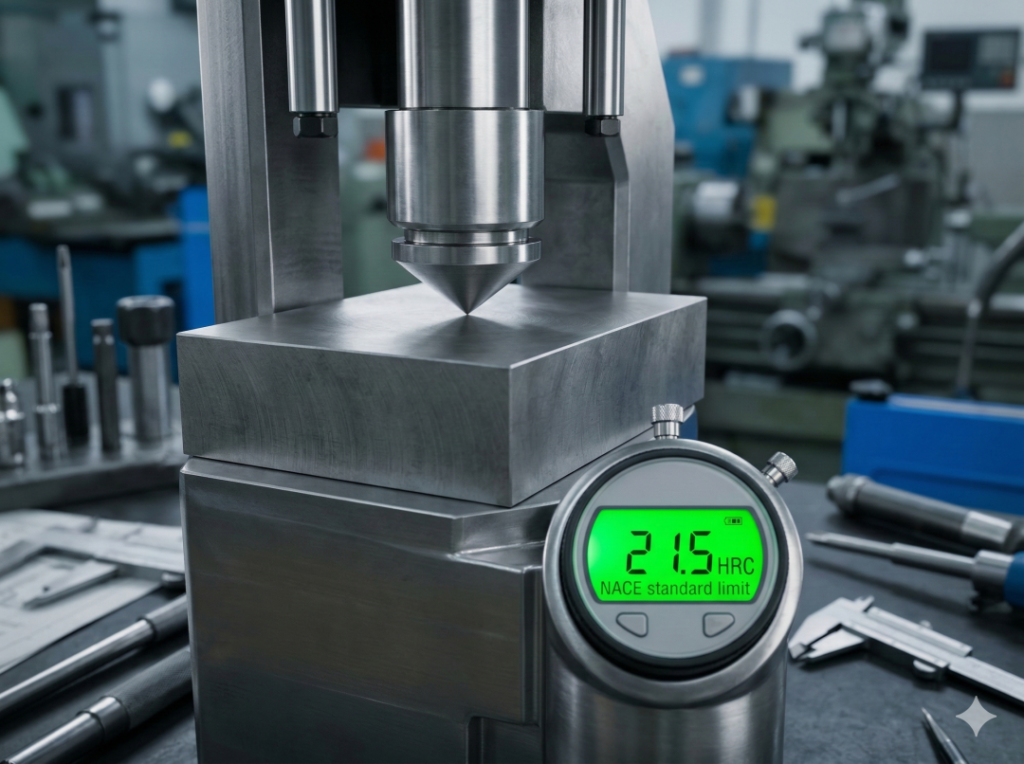
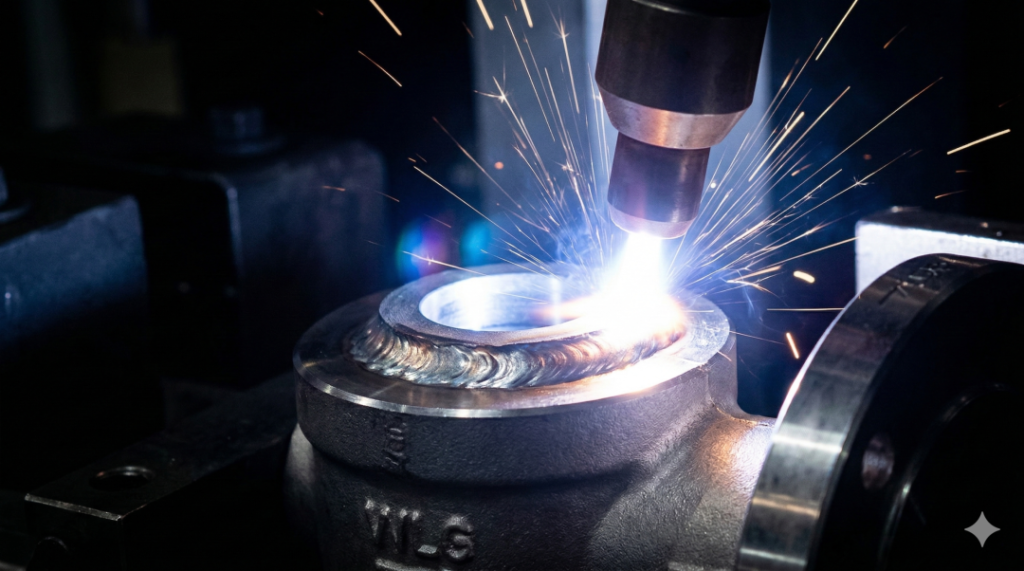
For standard materials like ASTM A216 WCB or A350 LF2, the maximum hardness must never exceed 22 HRC. To ensure this, SFANVALVE implements strict heat treatment protocols (Normalizing and Tempering) and mandatory Post-Weld Heat Treatment (PWHT). Without PWHT, the heat-affected zones (HAZ) of welds remain brittle and are the first points of failure in sour service.
2. The Trim Paradox: Solving the “Soft vs. Hard” Issue
Engineers face a contradiction: NACE requires materials to be “soft” (≤22HRC) to resist cracking, but industrial valves need “hard” surfaces (>40HRC) to resist erosion and cavitation.
Our solution at SFANVALVE involves high-performance overlays. We utilize Stellite 6 (Cobalt-based alloy) hardfacing on 316 SS or other NACE-compliant substrates. Because Stellite 6 is not an iron-based alloy, it is largely immune to the hydrogen diffusion mechanism that causes SSC, allowing us to provide a durable, wear-resistant sealing surface that remains fully compliant with ISO 15156.
3. Critical Stem Material: 17-4 PH
Valve stems require immense tensile strength. While 17-4 PH (UNS S17400) is a standard choice, it is highly susceptible to SSC in its peak-aged condition (H900). For sour service, we strictly utilize the H1150M or H1150D (Double Aging) heat treatment. This over-aging process reduces the hardness to ≤33HRC, providing the necessary toughness for safety in H2S environments.
Procurement Guide: MR0175 vs. MR0103
It is vital to specify your application environment:
| Feature | NACE MR0175 (ISO 15156) | NACE MR0103 (ISO 17945) |
| Primary Sector | Upstream (Exploration & Production) | Downstream (Refining & Processing) |
| Media Environment | Crude oil, raw gas, high chlorides | Refined products, controlled pH |
| Nickel Limit | Strictly <1.0% for low-alloy steels | No strict limit for nickel |
| Focus | Multi-phase environmental cracking | Sulfide stress cracking in refinery units |
Source:
Why Partner with SFANVALVE?
Navigating the complexities of NACE compliance requires more than just a certificate. It requires a deep understanding of MTR (Material Test Report) traceability and metallurgical consistency. Every NACE-compliant industrial valve from SFANVALVE undergoes rigorous inspection to ensure:
- Verified Chemical Composition: Controlling sulfur and phosphorus levels to enhance HIC resistance.
- Hardness Surveys: 100% verification of pressure-containing parts.
- Standard Alignment: Full compliance with the latest editions of API 6D and ASME B16.34.
For your next sour service project, don’t leave your plant’s safety to chance. Consult with our technical engineers to find the precise material match for your H2S and chloride concentrations.
Explore our NACE-compliant product range and request a technical consultation at:
SFANVALVE: Precision Engineering for the World’s Toughest Environments.
Explore our The Ultimate Guide to Industrial Valve Standards and Rigorous Testing