
Executive Summary: Choosing between a forged or cast valve body is a balance of pressure integrity and geometric complexity. For high-pressure (Class 1500+), lethal service (H2S), or cryogenic (LNG) applications, Forging is the industry mandated standard due to its zero-porosity grain structure. Casting remains the economical choice for large-diameter (DN300+) water and steam services where internal flow geometry is complex.
1. Casting (Liquid State Forming): The Freedom of Geometry
Casting is the primary manufacturing process for large-scale Industrial Valves. By pouring molten metal into a mold, manufacturers can create the intricate “S” shaped flow paths essential for Cast Steel Globe Valves.
The Advantage: Complex Internals
For large-diameter valves (DN300 to DN1200), casting is often the only viable method. It allows for integrated internal ribs and curved passages that minimize pressure drop—features that are nearly impossible to machine from a solid block.
The Engineer’s Field Note: The “Shrinkage” Risk
“In our pressure testing lab at SFAN, we’ve observed that casting defects like shrinkage cavities often cluster at the junction where the valve neck meets the flange. This is why for high-pressure Class 1500+ cast valves, we insist on 100% Radiographic Testing (RT) to ensure internal integrity.”
Common Cast Materials:
- Carbon Steel: ASTM A216 WCB / WCC
- Stainless Steel: ASTM A351 CF8M / CF3M
- Low-Temp Steel: ASTM A352 LCC / LCB
2. Forging (Solid State Forming): The Power of Grain Refinement
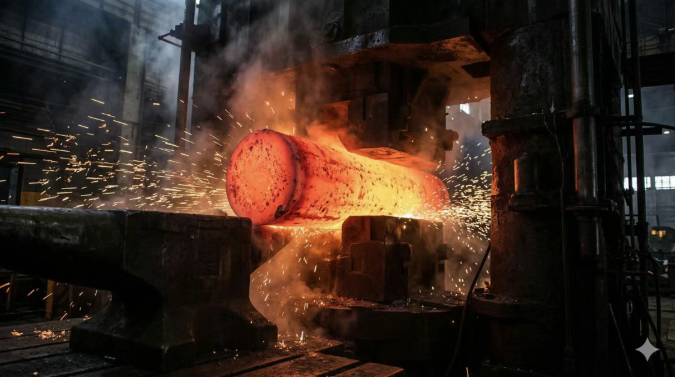
Forging is “mechanical alchemy.” By hammering or pressing solid steel (like ASTM A105 or F316) in a plastic state, we force the metallic grains to realign into a continuous, dense flow.
The Advantage: Structural “Zero-Leakage”
Under thousand tons or even 10,000 tons of hydraulic pressure, microscopic gas pores are crushed and “welded” shut. The resulting Forged Ball Valve is not just a shape; it is a directionally reinforced structure.
The Trade-off: Precision Machining Costs
Forging cannot produce hollow interiors. A forged body starts as a solid “near-net shape.” The internal cavities must be carved out using high-precision CNC deep-hole drilling. This results in higher material waste but a vastly superior safety factor.
3. Technical Comparison: Forging (ASTM A105) vs. Casting (A216 WCB)
This table summarizes the critical mechanical differences based on ASME B16.34 standards.
| Feature | Cast Valve (WCB / CF8M) | Forged Valve (A105 / F316) |
| Microstructure | Coarse, “Sponge-like” | Fine, “Fibrous” Grain Flow |
| Material Standards | ASTM A216 / A351 | ASTM A105 / A182 |
| Quality Factor (E) | 0.80 (Static Casting) | 1.00 (Perfect Integrity) |
| Impact Toughness | Moderate (Lower at -29°C) | Superior (Excellent at -196°C) |
| Typical Usage | Water, Oil, General Steam | HP Gas, Lethal Service, LNG |
| NDE Focus | Radiography (RT) for Porosity | Ultrasonic (UT) for Cracks |
4. Engineering Calculations: Why the “E” Factor Matters
The difference between these processes is hard-coded into the ASME B31.3 wall thickness formula:
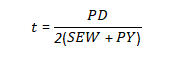
Why Forging is Lighter: Because the Quality Factor (E) for a Forged Body is 1.00(vs. 0.88 for casting), a forged valve can often have a thinner wall while maintaining a higher safety rating. A cast valve must be “over-engineered” and heavier to compensate for its inherent micro-porosity.
5. Selection Iron Law: When Must You Use Forgings?
Based on 15+ years of industrial valve supply experience, do not compromise on these four “Forging Mandatory” conditions:
- Ultra-High Pressure: Class 1500, 2500, or 4500. At these levels, gas molecules can actually permeate through the microscopic pores of a cast body.
- Lethal Service: High-concentration Hydrogen (H2) or Sour Gas (H2S). Any tiny inclusion in a casting could lead to a fatal through-wall leak.
- Deep Cryogenic: For LNG (-162°C). Castings suffer from low-temperature embrittlement; forgings maintain toughness and prevent catastrophic fracture.
- Small Bore (DN≤ 50): For 2″ and below, forging from bar stock for forged steel gate valve is actually more cost-effective and safer than casting.
6. NDT (Non-Destructive Testing) Guidelines
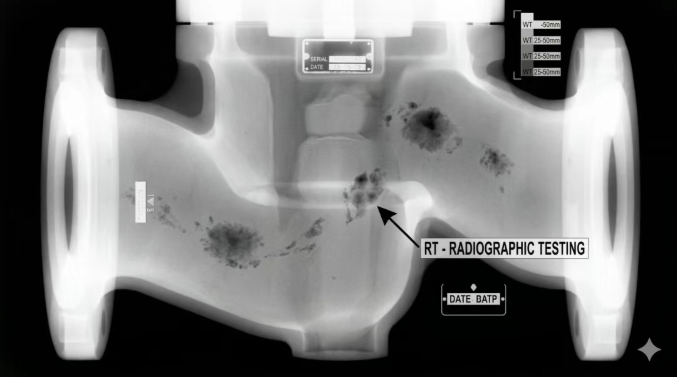
- For Castings: Prioritize RT (X-ray). It is the only way to “see” the internal gas holes and shrinkage.
- For Forgings: Prioritize UT (Ultrasonic). Since forgings have no pores, we look for “laps” or internal tears caused by improper forging temperatures.
Authoritative Review
This technical guide is reviewed by the SFAN Valve Engineering Department. All data aligns with API 6D and ASME B16.34 2024 revisions.