
This scenario frequently plays out during control valve selection meetings:
The procurement manager asks, “Why not use this ball valve? Its Cv value is twice that of the bulky globe valve, it costs half as much, and it’s much lighter.”
Meanwhile, the instrumentation engineer frowns: “This loop requires high-precision control; a ball valve probably won’t cut it.”
This is the eternal tug-of-war between “economics” and “control performance.”
Rotary valves (such as ball and butterfly valves) indeed have an overwhelming advantage in flow capacity and cost. But as “final control elements,” we can’t just look at how much fluid they can pass—we must also evaluate how accurately they can control it.
In this edition, we will dive into control theory to compare the fundamental differences between linear and rotary valves using two hardcore metrics: Gain and Deadband.
01. The Two Structural Camps
Before comparing them, let’s identify the representative players in each camp:
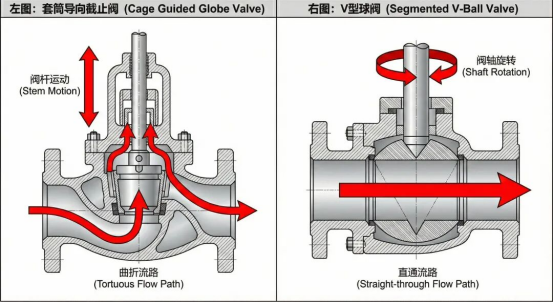
1. Linear Motion Valves The stem drives the plug up and down in a straight line.
- Representatives: Globe valves (including single-seat, double-seat, and cage-guided designs).
- Features: Extremely robust structure, tortuous flow path (strong energy dissipation), and easy to achieve precise flow characteristics.
2. Rotary Motion Valves The shaft drives the closure member in a rotational motion (typically 90°).
- Representatives: Ball valves (including V-port balls), butterfly valves, and camflex (eccentric rotary) valves.
- Features: Straightforward flow path, extremely high flow capacity, compact structure, and packing seals that more easily meet environmental compliance requirements.
Key Graphic: Structural Comparison
Check more details in “Globe Valve vs. Ball Valve : In-Depth Technical Comparison and Engineering Selection Report 2026“
02. Deep Dive #1: Installed Gain
In our previous issue (No. 002), we discussed flow characteristic curves. If we take the derivative (slope) of that curve, we get an even more critical metric: Valve Gain. Simply put, gain represents the valve’s sensitivity.
- Ideal State: We want the valve’s gain to remain constant throughout its entire stroke (e.g., 1.0). This means a 1% command from the controller always yields a 1% change in flow.
- Reality: Gain varies with the opening position.
The Achilles’ Heel of Rotary Valves: Excessive Gain & Nonlinearity Rotary valves (especially butterfly and standard ball valves) typically have extremely high inherent gain, particularly at small openings.
- The “Pop-open” Effect: When a ball or butterfly valve is opened just a crack, the unobstructed flow path causes the flow rate to spike instantly. This makes the valve overly sensitive during low-flow modulation; even a slight signal increase causes the flow to “jump,” easily leading to system oscillation.
- Drastic Gain Drop-off: Once the opening exceeds 60%-70%, the gain of rotary valves drops precipitously, making them highly sluggish.
By contrast, linear globe valves (when paired with appropriate trim design) are much easier to tune for relatively smooth and moderate installed gain across the full stroke. This is a massive blessing for PID parameter tuning.
03. Deep Dive #2: Mechanical Deadband & Stiction
If gain is a software-level issue, then deadband and stiction are hardware-level “chronic diseases.” They directly determine control precision.
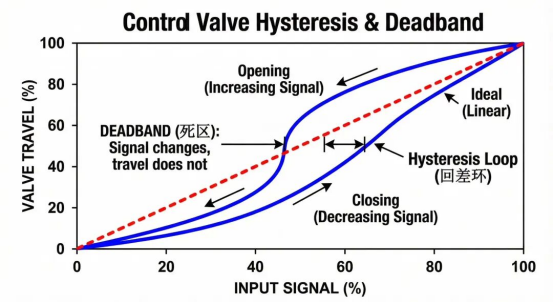
Deadband: Wasted Motion When you reverse the input signal direction (e.g., switching from “open” to “close”), the valve must travel through a certain amount of ineffective stroke before the closure member actually begins moving in the opposite direction. This wasted stroke is the deadband.
- The Rotary Challenge: To convert the thrust of a pneumatic piston actuator into rotational motion, rotary valves usually require complex linkages or rack-and-pinion mechanisms. Every mechanical clearance in the connecting pins and joint bearings accumulates into significant deadband.
- The Linear Advantage: Pneumatic diaphragm actuators drive the stem up and down directly, involving fewer connection points and naturally resulting in less mechanical deadband.
Stiction: The Deadly Static Friction Stiction occurs when static friction is significantly greater than dynamic friction. The valve sticks in place until the air pressure builds up enough to break the static friction, causing the valve to suddenly jump (slip) to a new position. This leads to the infamous “sawtooth wave” oscillation in the controlled variable.
- The Rotary Challenge: To achieve tight shut-off, rotary valve seats often exert massive lateral pressure on the ball or disc, creating extreme friction. Additionally, to meet low-leakage environmental standards, the rotating shaft packing is often compressed very tightly.
- The Linear Advantage: In globe valves, the plug and seat primarily make vertical contact, resulting in lower lateral friction during modulation.
04. Selection Guide: There Is No Best, Only What Fits
Back to the question at the beginning: How do we choose?
When to Choose Rotary Valves:
- High Flow, Low Pressure Drop: When a massive Cv is required, and system pressure isn’t too high.
- Dirty Media & Slurries: The straight-through flow paths of ball and butterfly valves resist clogging, and their rotational action provides shearing and self-cleaning capabilities.
- Tight Shut-off Requirements: Soft-seated ball valves easily achieve zero leakage.
- Space & Budget Constraints: When a compact, economical solution is needed.
When to Stick with Linear Valves:
- High-Precision Control: For critical loops demanding extremely tight deadband and hysteresis (e.g., < 0.5%), such as temperature or composition control.
- High Pressure Drops & Severe Service: When multi-stage anti-cavitation/anti-flashing trims are needed to handle high noise and erosion (refer to No. 001). This is the absolute home turf of globe valves.
Low-Flow Modulation: When tiny Cv values and high rangeability are required.
Conclusion
By choosing SFANVALVE, you are not just purchasing a component; you are gaining 15 years of engineering expertise and a commitment to global standards like API 6D and API 623. Our team provides full technical support, from Cv calculations to material compatibility analysis, ensuring your fluid control system operates with logical closure and industrial-grade reliability.