

In the previous issue about structural comparison, we concluded that globe valves hold an unshakable dominant position in the field of precision control.
Yet when you browse selection catalogs from Fisher, Valmet or Samson, you will notice globe valves feature products with drastically different internal structures.
Some are low-cost and simple, whose design has remained unchanged for decades.
Others are high-end and complex, with the plug encased inside a perforated metal cage.
This has been a decades-long “internal rivalry” within the globe valve family for half a century: the competition between traditional top-guided design and modern cage-guided design.
There is no absolute winner in this rivalry — only optimal solutions for specific working conditions. Today we will break down these two structures, and analyze their respective engineering advantages as well as inherent flaws.
01 The Purpose of Guidance: Why the Plug Must Stay Stable
Before diving into structural details, it is essential to understand the function of valve guidance.
Turbulent fluid flows at high velocity and impacts the plug inside a control valve. Without reliable guidance, the plug will vibrate violently like a flag fluttering in strong wind.
Consequences:
Stem fracture, packing leakage, positioner malfunction and severe mechanical noise.
The guidance system firmly supports the moving plug to resist lateral fluid thrust. Better guidance means superior performance under extreme pressure differentials.
02 Traditional Design: Top Guided Structure
This is the classic and simplest globe valve design, built on the philosophy of simplicity first and adequate performance.
Working Principle
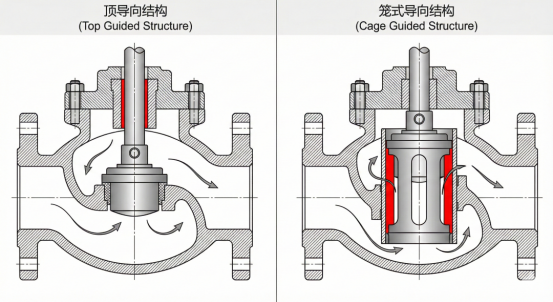
As shown in the figure, the plug is connected solely by a slender valve stem. The only guiding component is a small guide bushing mounted on top of the bonnet.
Analogy:
It is similar to a flagpole fixed only at the base. The stronger the wind acting on the top flag (plug), the more severely the pole sways.
✅ Advantages
Simple structure & low cost: Fewer components reduce casting and machining expenses.
Excellent fouling resistance: The open flow path around the plug prevents jamming or clogging, even when handling media with solid particles, slurry or viscous fluid. This is the key reason why it is still widely used today.
❌ Disadvantages
Poor stability: The guide point is far from the stressed plug. Under high pressure differential, lateral force generates large bending moment, easily causing stem deformation and intense vibration.
Limited functionality: Cannot be equipped with noise reduction or anti-cavitation features.
03 Innovative Design: Cage Guided Structure
Cage-guided valves were developed to solve the stability issues of top-guided valves under high pressure differentials, marking a revolution from point guidance to surface guidance.
Working Principle
As illustrated in the figure, the plug is fully enclosed inside a cylindrical cage, and slides closely along the cage’s inner wall.
Analogy:
Just like a piston moving inside a cylinder. The cage wall firmly restrains the plug against any lateral thrust.
✅ Major Advantages
Outstanding stability: The large guiding area delivers exceptional lateral rigidity, enabling the valve to withstand far higher pressure differentials than top-guided types.
Versatile performance:
Flow characteristics (linear / equal percentage) can be modified simply by replacing cages with different port shapes, without changing the valve body.
Multi-stage pressure reduction cages with dense holes can be adopted to eliminate cavitation and noise .
Superior tight shutoff: Precise centering ensures perfect matching between plug and seat, easily meeting Class V or even Class VI leakage standards.
04 Core Advantage of Cage Valves: Balanced Plug
The cage structure brings another key benefit: pressure balance.
In a conventional single-port valve, inlet fluid pressure pushes upward against the plug. The actuator has to generate much larger thrust to close the valve tightly, which requires bulky and costly actuators.
Balance Mechanism
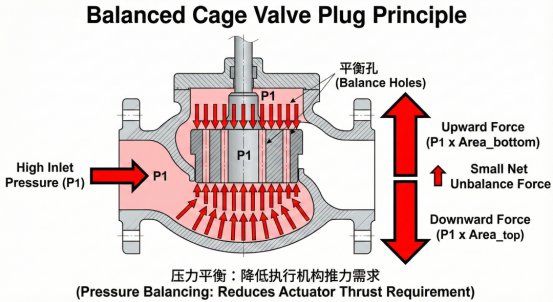
Several vertical balance holes are drilled through the plug.
High-pressure inlet fluid flows through these holes into the upper chamber of the plug. The downward pressure on the top and upward pressure on the bottom of the plug are nearly equal, with similar acting areas.
As a result, most unbalanced force is offset. The actuator only needs to overcome minimal residual force and packing friction to operate the valve smoothly.
Engineering Value
Smaller, more cost-effective and faster-response actuators can be used for high-pressure fluid control.
05 Selection Guide: Engineering Trade-off
Given the strengths of cage-guided valves, why are top-guided valves still widely applied?
The fatal weakness of cage-guided valves is poor fouling resistance.
The tight clearance between plug and cage can easily trap welding slag, sand grains or crystalline particles, causing valve jamming. Viscous media may also block the balance holes and disable the pressure balance function.