In the field of process industries, we are accustomed to talking about “opening,” “flow rate,” and “pressure differential.” However, if we view a control valve through the lens of fluid mechanics, you’ll realize it’s not just a mechanical device for regulating fluid, but a precision energy converter.
Why does a high pressure drop generate deafening noise? Why does a seemingly solid metal valve disc get “bitten” full of holes by water (cavitation)? All the answers lie in the interplay between pressure (potential energy) and flow velocity (kinetic energy). We will take you back to the very origin of physics to deconstruct that thrilling journey happening inside the control valve in a split second.
01. Redefining the Control Valve: It is an “Energy Dissipater”
If you ask an operator what a control valve does, he will say: “It controls flow.”
But if you ask a fluid physicist, he will tell you: “A control valve is a variable resistance element that introduces pressure loss.”
The essence of how a industrial valve works is not to directly “command” the fluid to flow faster. Instead, by changing the flow area of the channel, it forces the fluid to consume a portion of its energy (pressure), thereby changing its flow state.

There is no such thing as a free lunch. To control the flow, you must “pay” the pressure drop ( ΔP ) as the price.
Where does the energy go?
Most of the lost pressure does not disappear; it is converted into:
- Thermal Energy: A slight rise in fluid temperature.
- Sound Energy: Noise.
- Mechanical Vibration: Physical shaking of the valve body.
02. Bernoulli’s Principle: The Seesaw of Pressure and Velocity
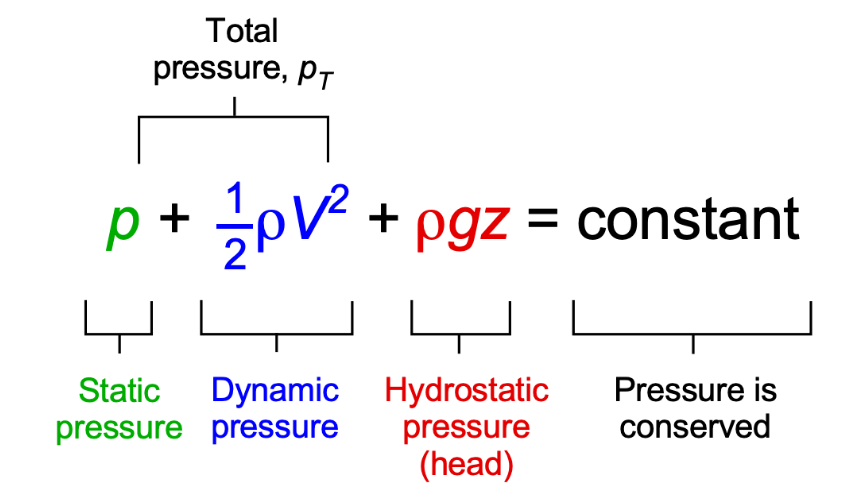
When fluid passes through a valve, it must obey the Law of Conservation of Energy. For incompressible fluids (such as water), we can describe this process using Bernoulli’s equation.
There are two main characters here:
- Static Pressure ( P ): The potential energy of the fluid.
- Dynamic Pressure: The energy possessed by the fluid due to its motion.
👇 Bernoulli’s Equation
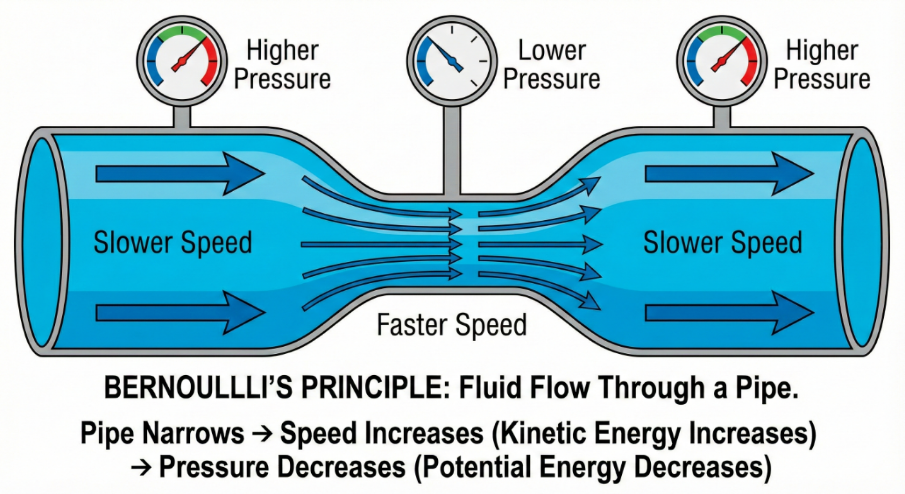
Key Diagram: Internal Pressure/Velocity Profile of the Valve
Key Physical Process Analysis:
- Constriction and Acceleration: When the fluid is forced through the narrow passage between the valve plug and the seat, the velocity must increase sharply to pass through.
- Pressure Drop: According to Bernoulli’s principle, as velocity increases, pressure must decrease. It is like a roller coaster; as kinetic energy increases, potential energy decreases.
03. Vena Contracta: The Eye of the Storm
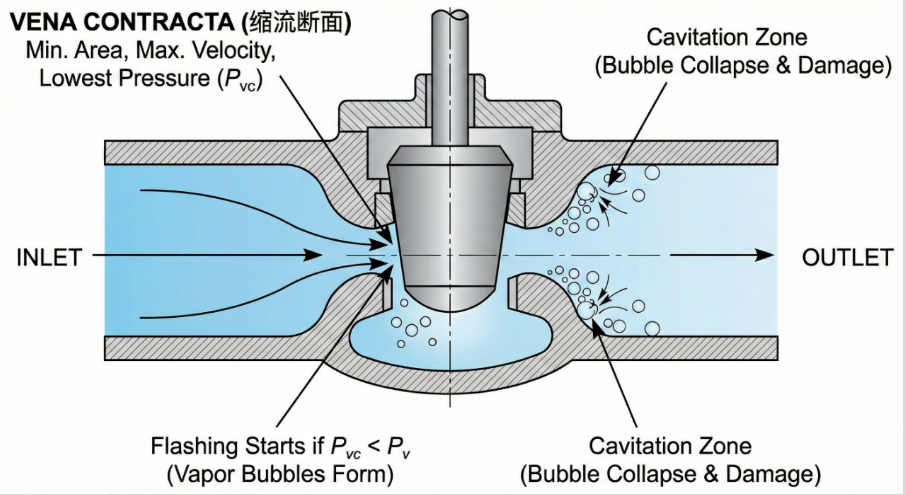
In the hydraulics of control valves, there is a crucial concept called the Vena Contracta.
It is not at the physical opening of the valve seat, but rather a point a very short distance downstream of the seat where the flow stream has the smallest cross-sectional area, the highest velocity, and the lowest pressure.
💡 Why is it important?
Because most “catastrophic failures” of control valves occur here or originate here.
- If the pressure at the Vena Contracta ( Pvc ) falls below the liquid’s saturated vapor pressure ( Pv ), the liquid will instantly boil and generate bubbles—this is the beginning of Flash Steam.
- If the pressure subsequently recovers and the bubbles collapse, it triggers Cavitation.
04. Pressure Recovery: The Double-Edged Sword of Streamlined Design
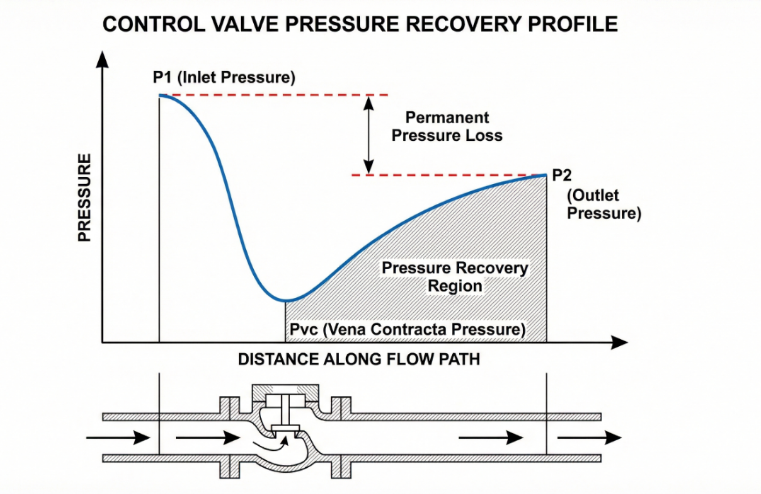
After the fluid passes the Vena Contracta, the flow path widens, the velocity decreases, and the pressure begins to rise. This is called Pressure Recovery.
Here, we introduce an extremely important dimensionless parameter: The Pressure Recovery Coefficient ( FL ).
👇 Pressure Recovery Coefficient
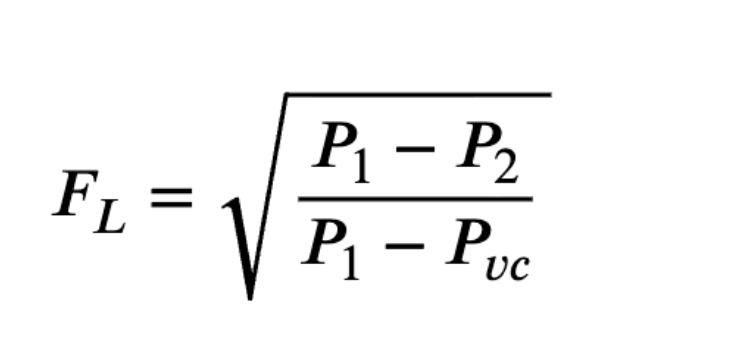
This formula tells us the valve’s ability to convert kinetic energy back into pressure.
Comparison of Two Valve Fates:
- High Recovery Valves (e.g., Ball Valves, Butterfly Valves): Low FL value
- Flow Path: Smooth, like a race track.
- Pressure: Drops deeply but recovers well.
- Pros: High flow capacity ( Cv ).
- Cons: Pvc is extremely low, making it very prone to cavitation.
- Low Recovery Valves (e.g., Globe Valves): High FL value (close to 0.9)
- Flow Path: Tortuous, with severe turbulence.
- Pros: Less prone to cavitation (because Pvc does not drop too low).
- Cons: High pressure loss.
05. Engineer’s Insight: Practical Help for Selection and Maintenance
Understanding these physical principles, what practical help does it offer for your selection and operation?
1. Don’t be deceived by “Fully Open”
The velocity when the valve is fully open may not be high, but at small openings for regulation, the velocity at the Vena Contracta may have already reached astonishing numbers (liquids may jet, gases may reach sonic speed).
2. Noise is Energy
The piercing noise emitted by a valve is essentially useless mechanical energy conversion. The louder the noise, the more intense the internal energy dissipation, and the stronger the destructive power to the equipment.
3. Predicting Failure
If you know the process conditions P1 and P2 , combined with the valve’s FL coefficient, you can calculate Pvc . If the calculation result is lower than the saturated vapor pressure, please stop using a standard valve immediately. Otherwise, in a few weeks, you will see a pitted and damaged valve plug.
SFAN VALVE: Your Trusted Partner in Wenzhou
As a professional manufacturer, Sfan Valve understands these fluid dynamics deeply. We engineer our valves to withstand these harsh conditions.
- Ball Valves: Ideal for high-flow, low-pressure drop applications. We offer durable solutions for Oil & Gas industries.
- Globe Valves: Designed for precise throttling and high-pressure applications where cavitation resistance is key.
- Gate Valves & Check Valves: Essential for on/off control and preventing backflow in your pipelines.
Are you facing specific challenges with noise, vibration, or cavitation in your system?
Visit our website Sfan Valve to explore our range of industrial flow control solutions, or contact our engineering team for a free consultation to select the right valve for your critical application.