
Keywords: Triple-Offset Butterfly Valve, TOV, Zero Leakage, Metal-to-Metal Sealing, Torque Sealing
📝 Introduction: Key Takeaways
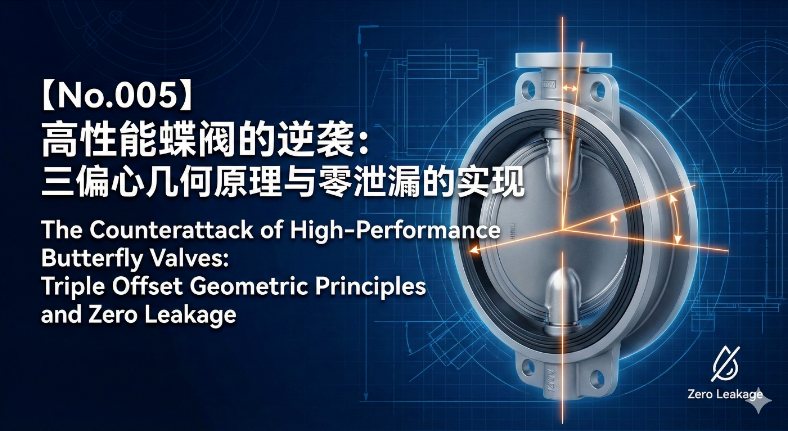
For a long time, butterfly valves were regarded by engineers as the practical, economical choice: inexpensive, lightweight, and structurally simple. However, they also carried a reputation for being unreliable—limited to soft rubber seats, unsuitable for high-temperature and high-pressure service, and prone to leakage after prolonged use.
In demanding operating conditions, the spotlight traditionally belonged to the bulky globe valve.
That was until a disruptive challenger emerged: the Triple-Offset Butterfly Valve (TOV).
By applying sophisticated geometric principles, this design fundamentally addresses friction between metal sealing surfaces, enabling metal-to-metal sealing with extremely low leakage. Under appropriate design and test conditions, it can achieve the highest shutoff performance required by certain applications.
Its arrival has given butterfly valves the ability to challenge the traditional dominance of globe valves in selected applications.
Today, we will break down this fascinating geometric puzzle and explore how three offsets can make such a remarkable difference.
01. The Achilles’ Heel of Traditional Butterfly Valves: Friction
To appreciate the significance of the triple-offset design, we must first understand the limitations of its predecessors.
1. Concentric Butterfly Valve
In a concentric butterfly valve, the shaft axis, disc center, and sealing geometry are arranged concentrically. This is the classic butterfly valve design.
The problem:
Throughout the opening and closing cycle, the disc sealing surface remains in contact with the seat, creating compression and sliding friction.
To maintain an effective seal, an elastic rubber seat is commonly used. Rubber has limited temperature resistance and can deteriorate over time, contributing to the traditional perception that butterfly valves have a relatively short service life and may develop leakage.
2. Double-Offset Butterfly Valve
To reduce friction, engineers introduced two geometric modifications.
Offset 1: The shaft axis is displaced from the center of the sealing surface.
Offset 2: The shaft axis is displaced from the pipeline centerline.
The result:
These two offsets create a cam-like effect. During the initial degrees of opening, the disc quickly moves away from the seat.
This significantly reduces friction and makes it possible to use harder seat materials, such as PTFE (polytetrafluoroethylene), in suitable designs, improving temperature and pressure capabilities compared with conventional soft-seated designs.
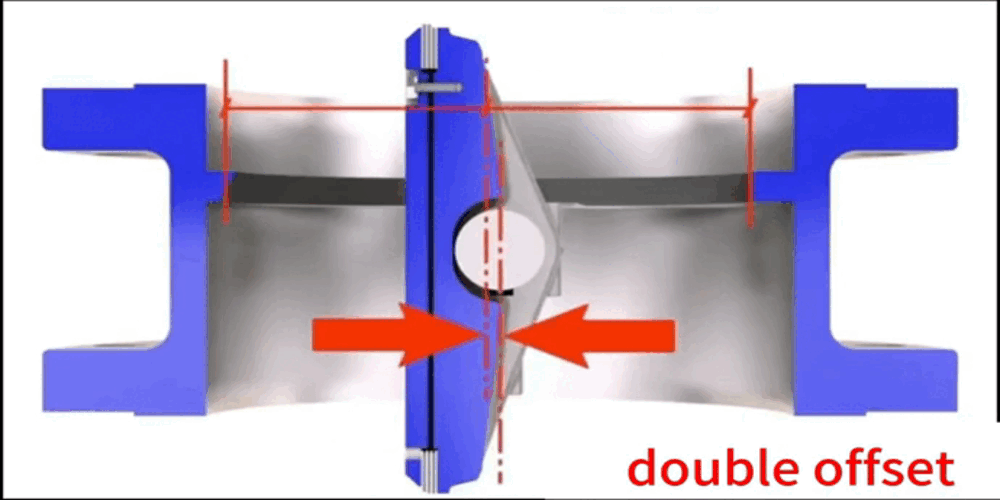
However, the double-offset design is not perfect.
As the valve approaches the fully closed position, sliding contact can still occur between the sealing components. When metal-to-metal sealing is required, this friction may cause severe galling, potentially resulting in sticking, damage to the sealing surfaces, or leakage.
02. The Magic of Geometry: Understanding the Triple Offset
To eliminate sliding friction between metal sealing surfaces during normal operation, engineers introduced a third—and particularly ingenious—geometric offset.
👇 An Explanation of the Triple-Offset Geometry
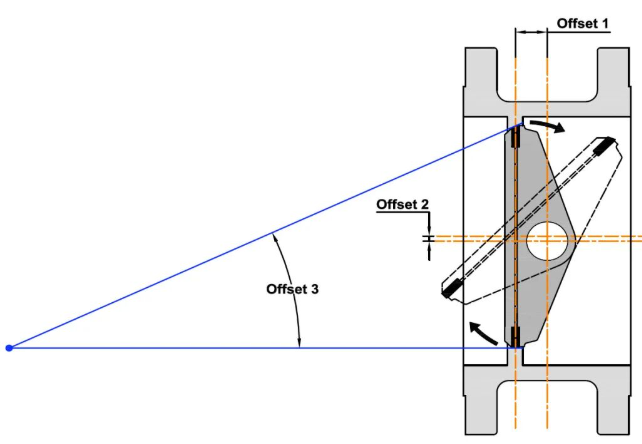
Examine the illustration carefully. It highlights three essential geometric features.
✅ Offset 1: The Shaft Axis Is Offset from the Sealing Plane
As shown on the right side of the illustration, the shaft does not pass through the center plane of the sealing surface. Instead, it is displaced backward from that plane.
✅ Offset 2: The Shaft Axis Is Offset from the Pipeline Centerline
As shown in the upper part of the illustration, the shaft is not located at the center of the pipeline. It is displaced upward or downward.
The purpose of the first two offsets:
They create a cam-like effect, allowing the disc to move rapidly away from most of the seat surface as the valve begins to open.
✅✅✅ Offset 3: The Conical Sealing Geometry — The Key Innovation!
This is the most difficult feature to visualize, but it is also the most critical.
Imagine that the butterfly valve seat is not a simple cylindrical surface. Instead, its sealing surface forms part of a conical geometry cut at an angle.
The axis of this cone does not coincide with the pipeline centerline. Instead, the two axes are angularly offset, creating the third offset.
A simple analogy:
Imagine slicing a piece from a cone at an angle, much like cutting a thin slice from a tapered piece of ham. The edge of that slice represents the geometry of the valve’s conical sealing surface.
This carefully engineered geometry is what makes the triple-offset design fundamentally different from conventional butterfly valves.
03. The Moment of Truth: Friction-Minimized Torque Sealing
What happens when all three offsets work together?
The result is a sealing mechanism designed to minimize sliding friction throughout the opening and closing cycle.
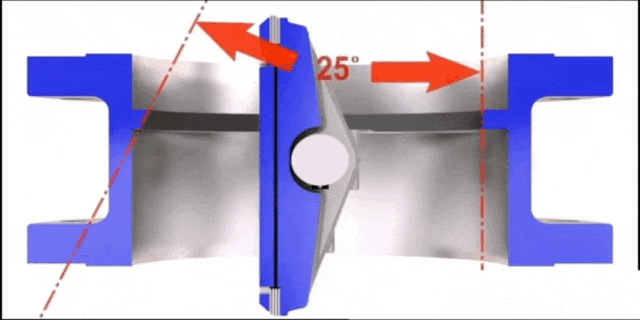
With triple-offset geometry, the disc sealing ring and the valve body’s seat are designed to make contact only as the valve approaches its fully closed position.
During the preceding opening and closing travel, the sealing surfaces remain separated, avoiding the continuous rubbing contact typical of conventional designs.
This is the principle illustrated by the “No Friction Zone” in the original diagram.
Less friction means less wear.
Less wear makes durable metal sealing surfaces practical.
The Evolution from Position-Based Sealing to Torque-Based Sealing
Traditional butterfly valves — Position-based sealing
The disc compresses an elastic rubber seat to create a seal. Greater compression may increase contact stress and, depending on the design, accelerate wear.
Triple-offset butterfly valves — Torque-based sealing
Instead of relying primarily on rubber deformation, the design uses the rotational torque applied by the actuator to press the resilient metal sealing ring against the inclined conical seat surface.
The carefully designed geometry and elastic deformation of the sealing components generate the contact pressure needed to achieve shutoff.
Properly controlled closing torque is essential: insufficient torque may result in leakage, while excessive torque can damage the sealing components.
This is the key to the triple-offset butterfly valve’s long service life and high-performance metal-to-metal shutoff capability.
The achievable leakage class depends on the valve design, materials, manufacturing tolerances, and applicable testing standard. Class VI performance should not be assumed for every metal-seated triple-offset butterfly valve.
04. Where Triple-Offset Butterfly Valves Excel
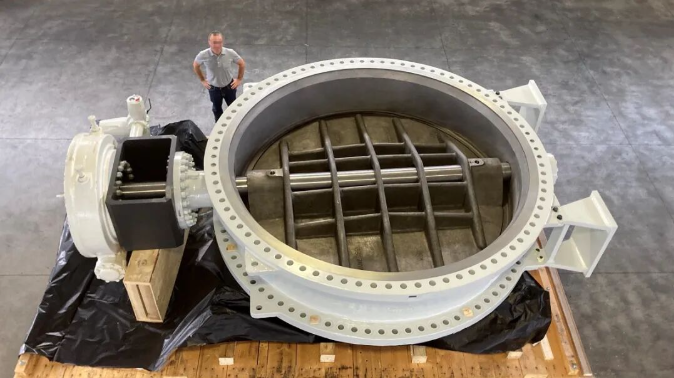
Thanks to this distinctive sealing technology, triple-offset butterfly valves have gained ground in high-performance applications, replacing globe valves and ball valves in certain services.
✅ Applications Where They Offer Major Advantages
1. Large-Diameter, High-Temperature, and High-Pressure Service
Consider a 24-inch, Class 600 steam pipeline.
A comparable globe valve may be extremely large, heavy, and expensive. Depending on the specific designs being compared, a triple-offset butterfly valve may weigh substantially less—potentially around one-third as much in some cases—while providing the required shutoff performance.
This can significantly reduce equipment weight, installation requirements, and overall project costs.
2. Frequent On-Off Operation
Because the triple-offset geometry minimizes sliding friction between the sealing surfaces, the valve can offer excellent wear resistance and long operating life when correctly selected and operated.
This makes it a strong candidate for high-performance on-off valve applications.
3. Cryogenic Service
Metal sealing components can be suitable for extremely low-temperature applications involving liquid nitrogen and liquefied natural gas (LNG), provided that the valve is specifically designed and qualified for cryogenic service.
Compared with rubber, properly selected metallic materials can retain useful mechanical properties at very low temperatures. However, cryogenic suitability also depends on thermal contraction, material selection, seat design, stem sealing, and the required leakage performance.
❌ Limitations: A Balanced Engineering Perspective
Although triple-offset butterfly valves can be used for flow control, they are not automatically the best choice for every throttling application.
As discussed in Article No. 001, their pressure recovery characteristics and susceptibility to cavitation depend on the valve geometry and operating conditions.
As discussed in Article No. 003, their flow characteristics can also produce high gain at certain low-opening positions, potentially contributing to unstable control in some applications.
Consequently, for precision control under high differential-pressure conditions, a cage-guided globe valve may still be the preferred choice, particularly when the application requires specialized pressure-drop management, noise attenuation, or cavitation control.
The final selection should always be based on process conditions, flow calculations, valve sizing, and the manufacturer’s engineering recommendations.
References
API Standard 609: Butterfly Valves: Double-Flanged, Lug- and Wafer-Type.
VAG Group Technical Paper: The Principle of the Triple-Offset Valve.