Actuator Physics (Part 2): Spring Range Selection — The Difference Between Bench Set and Installed Range
This is Article No.011 of “100 Articles on Control Valve Knowledge” On the nameplate of a control valve, you will often see a parameter like this: Spring Range (Bench Set): 0.8 – 2.4 bar At this moment, if you take a 4-20mA positioner (corresponding to 0.2-1.0 bar) and try to commission this valve, you may […]
The Ghost in the Control Loop: Deadband, Hysteresis, and Stiction — Which One Is the “Control Loop Killer”?
Have you ever encountered either of these situations? The flow trend on the DCS remains a perfectly flat line, even though it responds when the setpoint changes. Or the flow trend oscillates continuously like a sine wave. No matter how gently you tune the PID parameters, the oscillation just will not stop. When this happens, […]
The Myth of Valve Rangeability: Why Do Manufacturers Claim 50:1 When You Can’t Even Use 10:1 in the Field?
When reviewing a control valve data sheet, you will often come across an impressive specification: Rangeability: 50:1, or even 100:1. Many engineers see this figure and feel reassured: “My maximum flow rate is 100, and my minimum flow rate is 2. The required ratio is only 50:1, so this valve should easily handle the job.” […]
Leakage Classes and Rangeability: The “Lower Limit” and “Upper Limit” of Control Valve Performance
Control Valve Knowledge Series — No.007 Leakage Classes and Rangeability: The “Lower Limit” and “Upper Limit” of Control Valve Performance Keywords: Leakage Class, ANSI/FCI 70-2, Rangeability, Turndown Ratio, Class VI 📝 Introduction If the Cv value determines how much work a valve can do, then leakage class and rangeability determine how well it performs. Leakage Class The lower […]
The Story of the Cv Flow Coefficient: From Definition to Calculation — A Guide to Avoiding Common Pitfalls
Keywords: Cv Value, Kv Value, Flow Calculation, Valve Sizing, Choked Flow 📝 Introduction: Key Takeaways On a control valve datasheet, one of the most prominent parameters is always the Cv value. It is the “currency” of a valve’s flow capacity. If the valve is oversized, it may operate at very small openings for extended periods, potentially […]
The Comeback of High-Performance Butterfly Valves: Triple-Offset Geometry and the Achievement of Zero Leakage
Keywords: Triple-Offset Butterfly Valve, TOV, Zero Leakage, Metal-to-Metal Sealing, Torque Sealing 📝 Introduction: Key Takeaways For a long time, butterfly valves were regarded by engineers as the practical, economical choice: inexpensive, lightweight, and structurally simple. However, they also carried a reputation for being unreliable—limited to soft rubber seats, unsuitable for high-temperature and high-pressure service, and prone […]
Actuator Physics (Part 1): How Does the “Muscle” of a Valve Use Air to Generate Force?
In previous articles, we have discussed either macroscopic flow characteristics, such as rangeability, or microscopic dynamic errors, such as deadband and stiction. But one fundamental question remains unanswered: What actually makes a valve move? When a pipeline carries fluid at a high pressure of 100 bar, or when a valve is so large that a […]
Globe Valve deep Dive: Engineering Battle of Cage Guided and Top Guided
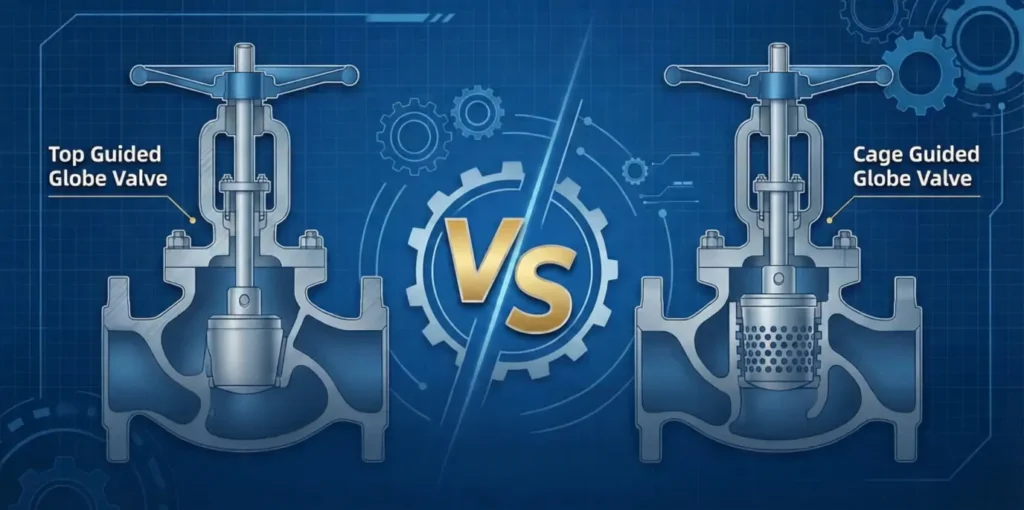
In the previous issue about structural comparison, we concluded that globe valves hold an unshakable dominant position in the field of precision control. Yet when you browse selection catalogs from Fisher, Valmet or Samson, you will notice globe valves feature products with drastically different internal structures. Some are low-cost and simple, whose design has remained unchanged […]
Linear vs. Rotary Motion
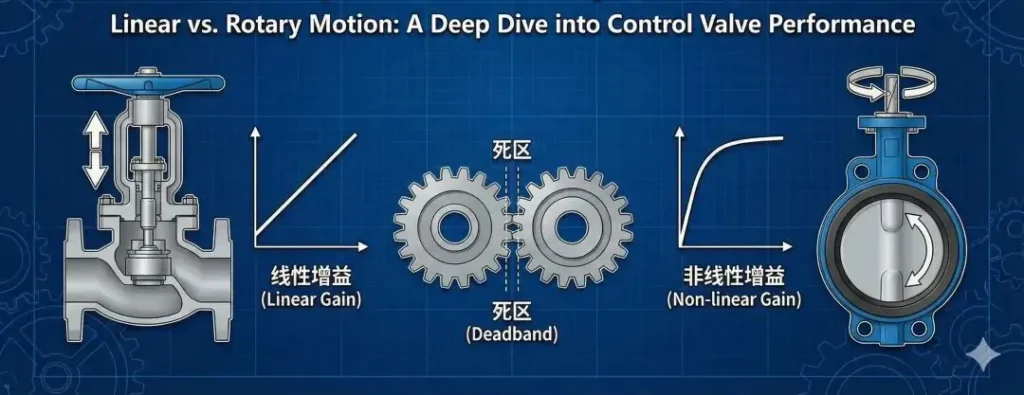
This scenario frequently plays out during control valve selection meetings: The procurement manager asks, “Why not use this ball valve? Its Cv value is twice that of the bulky globe valve, it costs half as much, and it’s much lighter.” Meanwhile, the instrumentation engineer frowns: “This loop requires high-precision control; a ball valve probably won’t […]
The truth about flow Characteristics

Why do we recommend the seemingly complex “equal percentage” valve over the intuitively simple “linear” valve in 90% of process control applications? Many engineers assume that controlling a linear process requires a linear valve. This is a massive misconception. In real-world piping systems, ideal “inherent characteristics” are inevitably distorted by harsh realities into “installed characteristics.” […]